 DanceWith.co.uk
Dance with History
Prehistory
"Go back ten thousand years and you will find humans toiling away at the many mundane activities required for survival: hunting, food gathering, making weapons and garments, beginning to experiment with agriculture. But if you land on the right moonlit night or seasonal turning point, you might also find them engaged in what seems, by comparison, to be a gratuitous waste of energy: dancing in lines or circles ...well before people had a written language, and possibly before they took up a settled lifestyle, they danced and understood dancing as an activity important enough to record in stone."
Antiquity
"Socrates recommended dance to his students ... and danced among his friends after dinner" (470-399 BC)
"Plato saw dance as a desirable method "for the acquisition of noble, harmonious and graceful attitudes"" (427-347 BC)
"Dance is as old as love" Lucian of Samosata (120-180 AD)
1285 Make Merry
From accounts of the Tournaments at Chauvenci, attended by English Knights:
"After eating, they rose to their feet and removed the tables and trestles. They played flutes, tabors and flageolets and generally made as merry as could be. Then a song began. Everyone came forward eagerly to sing 'Cursed be he who does not join the dance'. If you had seen the ladies come forward, holding the gentlemen by the hand, you would have thought it a fine and pleasing sight. There is none who does not make merry."
"Apres mangier, en piez leverent.
Tument tables, tument tretel.
Trompent flaiot, tabors, fretel
Eslorent bien en lor saison
Lors comanca une chanson
De chanter chaseuns cuers s'avance
'Mal dehait ait qui ne vient en la dance'
Qui dont veist dames venir,
Bachelers par les mains tenir,
Bel li samblast et bel li fust
Sans contrebit et sans refust
N'i a celui qui ne s'esjoie."
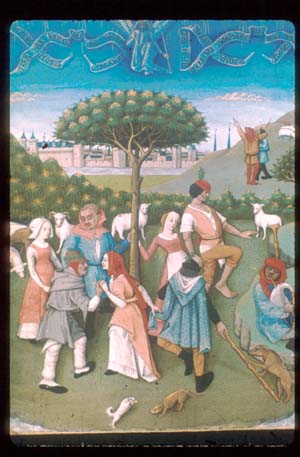
1400s La Danse Champétre
From the manuscript Heures de Charles O'Angouleme
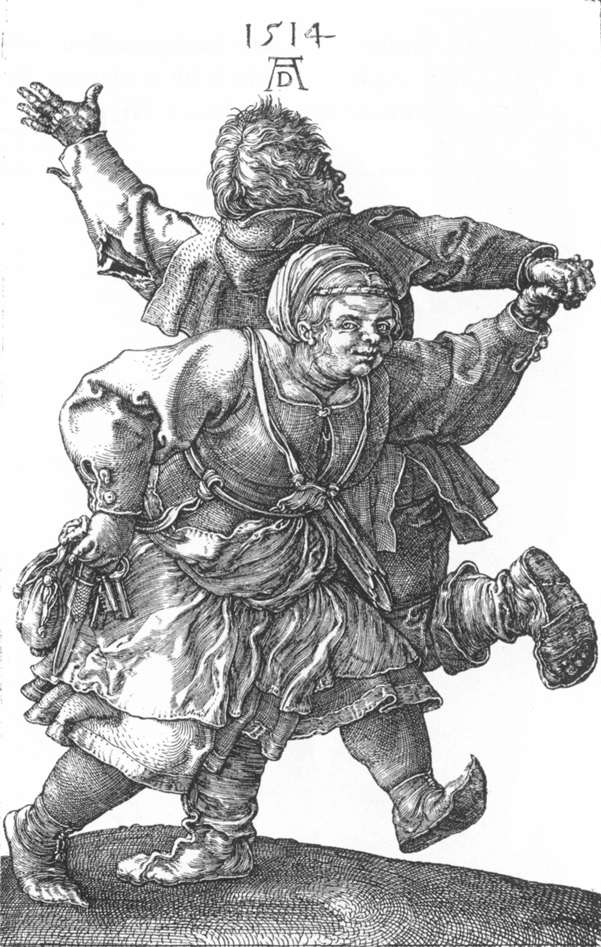
1514 Dancing Peasants by Albrecht Dürer
1566 The Wedding Dance by Pieter Brueghel the Elder
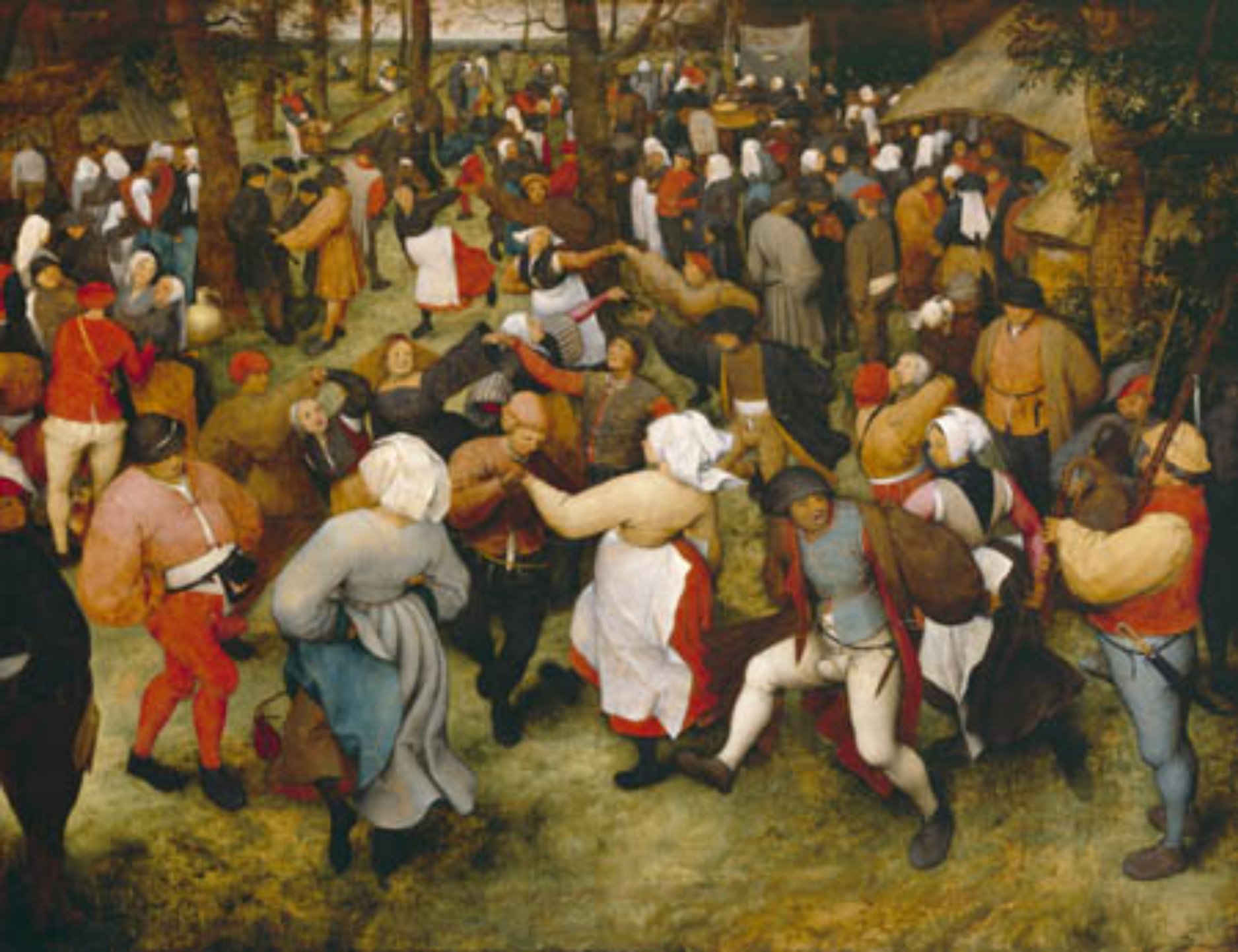
Source: Detroit Institute of Arts
1588 Orchésograhie
"Dancing is an art adapted by the youthful, agreeable to the aged and very suitable for all"
1603 Elizabeth I
"Queen Elizabeth herself was... an eager dancerwho still performed the vigorous galliard at the age of seventy."
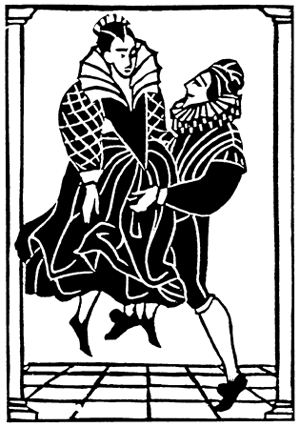
Woodcut taken from an oil painting hanging in Penshurst Palace depicting the Earl of Leicester dancing La Volta with Queen Elizabeth I.
1651 The English Dancing Master
"[Dance] This Art, Anciently commended as Excellent for Recreation, after more serious Studies, making the body active and strong, graceful in deportment, and a quality very much beseeming a Gentleman"
1657 Oliver Cromwell dances till dawn
"During the Commonwealth (1649-1660) ... private dancing was consider an acceptable activity, as illustrated by the fact that the Lord Protector Oliver Cromwell himself danced till dawn at a ball to celebrate his daughter's wedding."
"The wedding feast [for Cromwell's daughter] scaled new heights of magnificence, not only were there forty-eight violins and fifty trumpets, but also "mixt dancing" until five o'clock in the morning"
1774 The Pleasure of Dancing
"If this passion for dancing is a fault, I will gladly confess I know of nothing I value more. And if there is something on my mind, I pound out a quadrille and everything immediately is all right again."
1812 "Waltz first danced in England"
1813 Jane Austen's Pride and Prejudice
[Sir William Lucas] "What a charming amusement for young people this is, Mr Darcy! - There is nothing like dancing after all. - I consider it as one of the first refinements of polished societies."
[Mr. Darcy] "Certainly, Sir; - and it has the advantage also of being in vogue amongst the less polished societies of the world. - Every savage can dance.""
1816 A Companion to the Ballroom
"Changing partners in all Balls and Assemblies ought to be optional, as in many companies it is more properly convenient."
1890s "Rumba arose in Havana"
1895 Waltz
"The Waltz is the favourite dance of modern times and has held its own for the last fifty years. Good Waltzing means good dancing, and you cannot be said to dance unless you Waltz."
1896 Empress Ballroom, Blackpool
"The biggest dance halls were in Lancashire... The Empress Ballroom flourished throughout the summer, holding some three thousand dancers."
1898 Arthur Morris of Leeds
"Arthur Morris of Leeds wrote the tune for and arranged the dance, Veleta, probably the most popular sequence dance of all time."
1899 Blackpool Tower Ballroom opens
1900s A New Era
Franks describes a progression from courtly steps as a democratic and fun-seeking society expresses the emotions of a new era by interpreting music in smooth flowing dances based on the natural walk.
1900 James Finnigan of Manchester
"James Finnigan devises the Military Two Step. He is also the first President of the Manchester and Salford Association of Teachers of Dancing, founded in 1903, and his grand-daughter still teaches dancing.
1911 Jazz, Syncopation and Ragtime
Irving Berlin composes Alexander's Ragtime Band.
1911 Tango
"... it became fashionable in Paris, and later in London, to have 'Tango parties' in drawing-rooms. They also began introducing dancing couples into restaurants, and [George Grossmith] was one of the first among the ordinary people watching to get up with a lady and dance between the tables. Other spectators followed suit."
1914 Vernon and Irene Castle
"People can say what they like about rag-time. The Waltz is beautiful, the Tango is graceful. One can sit quietly and listen with pleasure to them all; but when a good orchestra plays a rag one has simply got to move."
Source Thompson
1914-1918 Foxtrot
"1914 - The Foxtrot first danced in UK, described by a contemporary as 'very rollicking, and has a tendency to put everyone in a good humour'."
"When war came, the most popular form of relaxation for the men on leave was a dance... The fascinating lilt of the Foxtrot tunes and the informal nature of the steps appealed so much that in a few months the Foxtrot swept all other dances except the Rag off the ballroom floor.
"Foxtrot has an eponymous hero, Harry Fox, who was among the first to introduce it to the vaudeville stage, but the suggestion it was named after the gait or pace of the horse, known in the West as 'Foxtrot', is more plausible.
"...one prominent teacher, in reply to a request for a definition of the basic Foxtrot steps, wrote at the time: 'There are but two things to remember; first a slow walk, two counts to a step; second a trot or a run, one count to each step.'"
1920 English Style "Modern" Ballroom
Formalisation of steps at conferences called by Dancing Times, formerly Ballroom Dancing Times, and now Dance Today.
1920s Dance Halls in Manchester
"Dance Halls and Dancing Schools [in 1920s Manchester]
"In the first half of [the 20th] century dancers throughout the Manchester area were well provided for, with splendid ballrooms and dance halls, and many excellent dancing schools, where dancing could be enjoyed six nights a week.
"The Ritz on Whitworth Street West was the best known. It was mainly frequented by first class dancers who were assured of finding good partners, or they could engage one of the professional partners at sixpence a dance. Most people learnt the basic steps at their local dance hall before becoming confident enough to set foot in the Ritz.
"Other than Finnigan's [est. 1877], Cadman's [est. 1903] on Ashfield Road in Sale is the oldest surviving dance hall."
"Dancing in Jinks's boatyard"
1920s Lindy Hop, Boogie Woogie and Swing Jazz
In the Savoy Ballroom, Harlem NY, "Shorty" George names a street jazz dance as the "Lindy Hop" in honour of Charles Lindenbergh (1928).
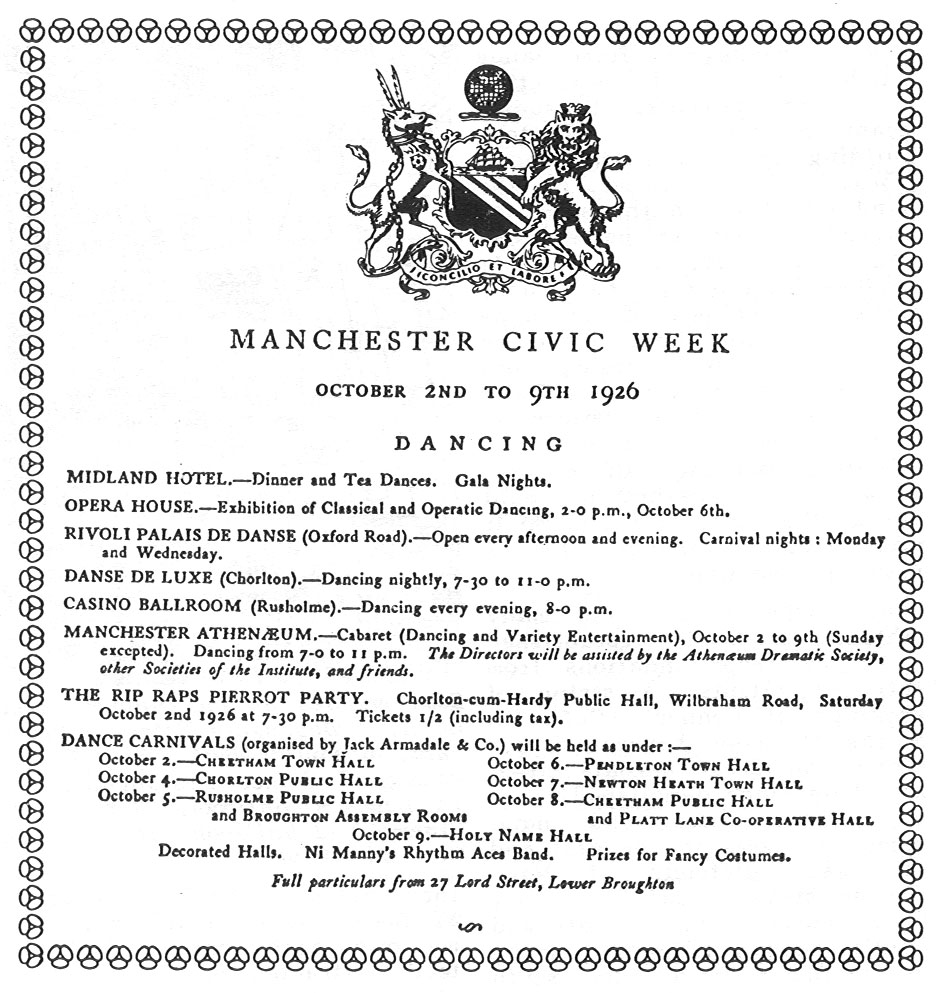
October 1926 Manchester Civic Dance Parties
Dinner and Tea Dances, Fancy Dress, Shows, Cabaret, Carnival and Gala .
1929 First Quickstep
"The dance called 'Quick-Time Foxtrot and Charleston' became known as the 'Quickstep'.
1930s Ballroom and Latin American
"The recent period of Ballroom Dancing history starts with the four standard dances: Waltz, Foxtrot, Quickstep and Tango."
"On the Latin American side, that delightfully light-hearted dance, the Samba, arrived in Europe from Brazil."
1931 Rhumba
"In 1931 bandleader Don Azpiazu rearranged 'El Manicero' (The Peanut Vendor) and turned the Cuban 'son' music into a Rhumba to suit Western tastes." (NB Steward denotes Rhumba spelt with an 'h' as a westernised version of Cuban Rumba.)
1934 Fred and Ginger
Cole Porter's musical film The Gay Divorcee with Astaire and Rogers performing "Night and Day".
1934 Cab Calloway records Jitter Bug
1938 Mambo
Orestes Lopez composes a song called Mambo in Cuba.
1945 British Jive Championships
"... includes a challenge match between world jitterbug champions and world jive champions."
1953 Cha Cha Cha
"Music is never static and by 1953 a further 'new' rhythm and dance swept Cuba. Enrique Jorrín recorded his tune 'La Engañadora' using a rhythmic pattern we now call Cha Cha Cha."
1954 Rock 'n' Roll
Bill Haley and His Comets record "Rock Around the Clock".
1960 Chubby Checker records The Twist
"Easy to learn, fun to dance with its distinctive beat, young and old twisted the night away. The Twist brought with it a new idea: dancers did not need partners."
1966 Salsa as Cuban dance music
"The first self-conscious use of 'salsa' to describe modernized Cuban dance music came in 1966 by Venezuelan radio DJ, Danilo Phidiad Escalona."
1977 Disco Hustle
danced by John Travolta in Saturday Night Fever
1980s Rave parties at Manchester's Haçienda nightclub
1990s French Jive or Modern Jive
Erroneous titles for accessible Jive-Salsa fusion, "featuring many spinning actions for lady and imprecise foot positions."
1997 "Dance, even if you have nowhere to do it but your living room."
Mary Schmich "Advice, like youth, probably just wasted on the young" from Chicago Tribune, 1st June. Quoted in Baz Luhrmann's song Everybody's Free (To Wear Sunscreen).
1998 Salsa
Buena Vista Social Club released by Ry Cooder and the Afro Cuban Allstars leads to an explosion across Europe of Son Music and Salsa Dancing.
Bandleader, Wille Colón, writes, "Salsa's magic has always been transmitted from skin to skin - in a seductive dance clinch, and through a sheet of dried goats skin - the voice of the drum."
Why do we dance?
"Dance is an instinctive mode of muscular reaction... expressing feelings or emotions, or simply expressing excess energy.""
"The desire to dance is one of the primitive instincts of mankind. It has been said that 'dancing is older than anything except eating, drinking and love'.
"It is a fact that emotion stimulates the body into movement. Even primitive cave-drawings depict men dancing. The desire to move in response to emotion is a physiological fact which will survive as long as people exist. The persistence of rhythm and its intimate association with sex and life itself is undeniable, and rhythm and movement come together in dancing"
Humanity includes dancing, and today we dance for fun.
External Links
Dance with History web links:
An American Ballroom Companion: Dance Instruction Manuals 1490-1920 from the US Library of Congress.
Brief Histories of Dancing from centralhome.com.